content type paperpublished October 2025
FS-DFM: Fast and Accurate Long Text Generation with Few-Step Diffusion Language Models
AuthorsAmin Karimi Monsefi†‡, Nikhil Bhendawade, Manuel R. Ciosici, Dominic Culver, Yizhe Zhang, Irina Belousova
FS-DFM: Fast and Accurate Long Text Generation with Few-Step Diffusion Language Models
AuthorsAmin Karimi Monsefi†‡, Nikhil Bhendawade, Manuel R. Ciosici, Dominic Culver, Yizhe Zhang, Irina Belousova
Autoregressive language models (ARMs) deliver strong likelihoods, but are inherently serial: they generate one token per forward pass, which limits throughput and inflates latency for long sequences. Diffusion Language Models (DLMs) parallelize across positions and thus appear promising for language generation, yet standard discrete diffusion typically needs hundreds to thousands of model evaluations to reach high quality, trading serial depth for iterative breadth. We introduce FS-DFM, Few-Step Discrete Flow-Matching. A discrete flow-matching model designed for speed without sacrificing quality. The core idea is simple: make the number of sampling steps an explicit parameter and train the model to be consistent across step budgets, so one big move lands where many small moves would. We pair this with a reliable update rule that moves probability in the right direction without overshooting, and with strong teacher guidance distilled from long-run trajectories. Together, these choices make few-step sampling stable, accurate, and easy to control. On language modeling benchmarks, FS-DFM with 8 sampling steps achieves perplexity parity with a 1,024-step discrete-flow baseline for generating 1,024 tokens using a similar-size model, delivering up to 128 times faster sampling and corresponding latency/throughput gains.
How to Guide Your Language Flow
September 23, 2026research area Methods and Algorithms
We introduce a new method to guide flow matching models. Our approach, which we call probe guidance, uses the frozen internal states of an existing diffusion model to construct a guidance signal. This works using a similar principle as autoguidance, but eliminates the need for an additional forward pass at inference time and provides a reliable path to ensure that the weak and strong model share similar dynamics. We apply and benchmark this…
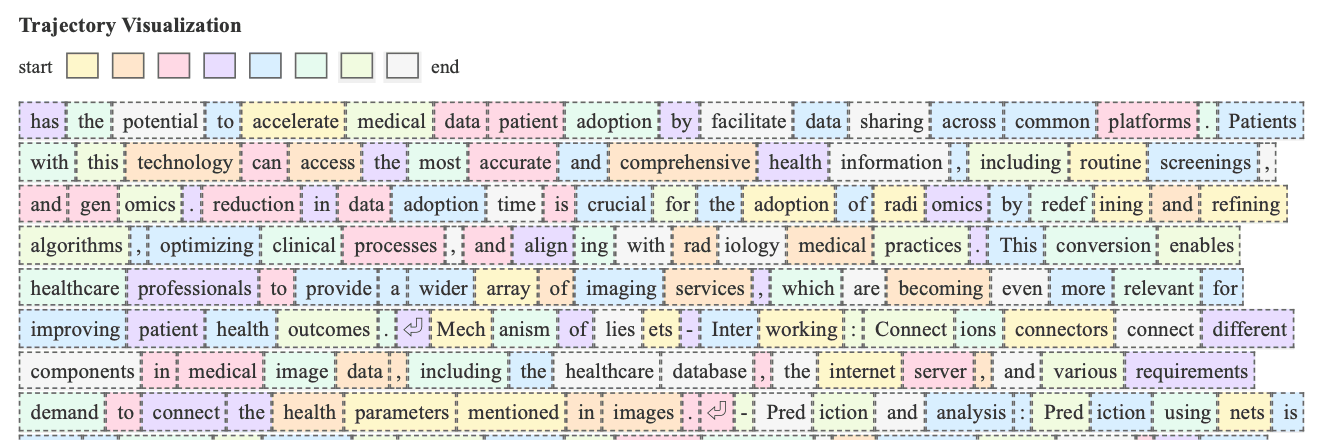
Trajectory as the Teacher: Few-Step Discrete Flow Matching via Energy-Navigated Distillation
September 16, 2026research area Methods and Algorithms, research area Speech and Natural Language Processing
Discrete flow matching generates text by iteratively transforming noise tokens into coherent language, but may require hundreds of forward passes. Distillation uses the multi-step trajectory to train a student to reproduce the process in a few steps. When the student underperforms, the usual explanation is insufficient capacity. We argue the opposite: the trajectory is the bottleneck, not the student. Each training trajectory is built through a…

Our research in machine learning breaks new ground every day.